Software cost is one of the first questions a freight brokerage should ask. It is also one of the easiest questions to answer poorly.
A monthly subscription is only one part of the investment. The real cost depends on the work the platform needs to support, the systems it must connect with, the data that must move accurately, and the change required across operations and accounting.
This guide helps freight brokers compare software costs in the context that matters: the workflow from quote through carrier assignment, document collection, invoicing, and reporting.
Start with the operating workflow, not the price sheet
Before comparing quotes, document how a load moves through your brokerage today. Include the handoffs between sales, operations, carrier management, accounting, and leadership. A lower-priced platform can become expensive if staff must continue managing the same work in spreadsheets, inboxes, or disconnected tools.
Map the steps that create the most rework. Common examples include entering shipment details more than once, tracking paperwork in email, manually updating customers, reconciling invoices, or researching carrier information at the last minute. These are the workflows a software evaluation should test.
Understand the major parts of freight broker software cost
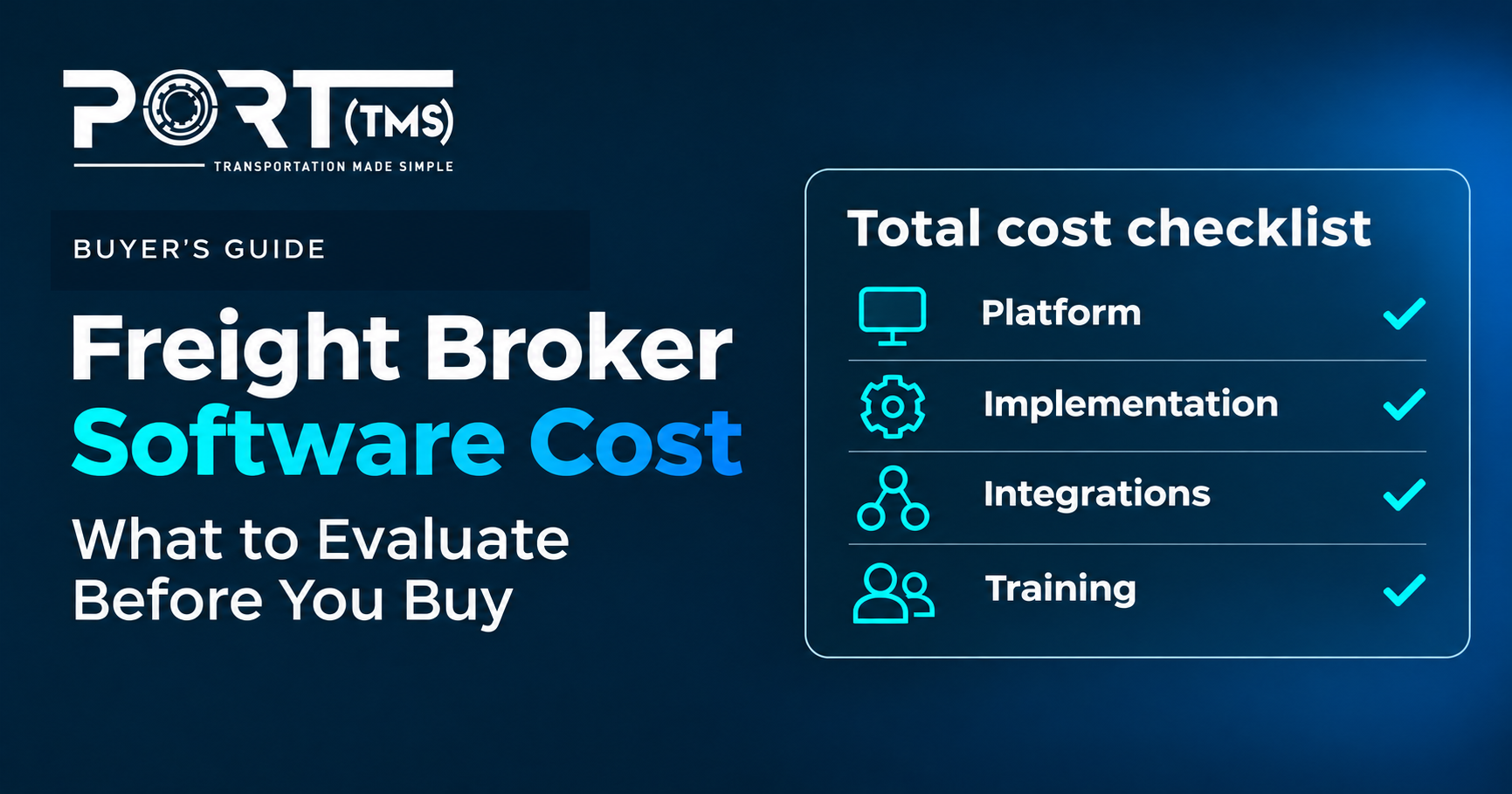
Software pricing can include more than a recurring subscription. Ask each provider to explain which costs are fixed, which vary by users or shipments, and which may change as your brokerage grows.
Platform and user access
Start with the core platform fee and the number of people who need access. Clarify whether operations, sales, accounting, leadership, or external users require separate licenses. Ask how the model changes when your team, shipment volume, or branch count changes.
Implementation and training
Implementation work may include configuration, workflow design, data migration, user setup, testing, and training. A quote should make clear what is included, what the provider expects your team to complete, and how both teams will decide the system is ready for go-live.
Integrations and data exchange
Load boards, accounting software, tracking tools, document workflows, payment systems, and CRM platforms can each add scope. An integration can have setup work, subscription costs, data-mapping requirements, or ongoing support considerations. Ask what information moves in each direction, how exceptions are handled, and who owns support when something fails.
Operational change
The cost of adoption is not always shown on a proposal. Teams need time to learn new processes, clean up data, test real scenarios, and retire workarounds. Build that work into the plan rather than treating it as an afterthought.
Compare total operating impact, not just subscription price
The most useful comparison connects cost to outcomes your brokerage can observe. For example, estimate how much time is spent per load on duplicate entry, status updates, document chasing, invoice preparation, carrier onboarding, and exception management. Then identify which steps a prospective platform is designed to reduce or make easier to manage.
Do not assume a requested feature will work the same way across vendors. Ask to see the workflow in a demo using a realistic load and a realistic exception. If a system claims to automate a task, clarify what begins the automation, what data it uses, who reviews exceptions, and what remains manual.
Evaluate integrations before treating them as a checkbox
For many brokerages, integration quality matters as much as the core transportation management system. The goal is not to connect every available tool. The goal is to create a reliable flow of information through the systems your team actually uses.
Build an integration checklist that includes:
- The current system and business owner
- The data that needs to move between systems
- Whether the exchange must be real time, scheduled, or manual
- What happens when a record does not match or a transfer fails
- How reporting and reconciliation will be handled
- Any setup, support, or transaction costs
Accounting deserves special attention. Confirm how invoices, charges, payments, customer information, carrier records, and supporting documents move between operations and accounting. A smooth handoff can reduce avoidable follow-up and make month-end work easier to control.
Factor carrier processes and risk controls into the evaluation
Software does not replace a brokerage’s carrier standards, but it can influence whether those standards are applied consistently. During evaluation, ask how the system supports carrier onboarding, documentation, internal approval steps, record visibility, and exceptions.
Also test the workflow under pressure. What happens when carrier information changes, paperwork is incomplete, a shipment requires a reassignment, or a customer needs an update? A platform should help the team see what is missing and who owns the next step.
Use a go-live plan to expose hidden costs
A go-live plan turns a vendor promise into a practical comparison. Ask each provider to outline the work required before launch, the people involved, the training approach, the test scenarios, and the support available in the first weeks after implementation.
A useful plan includes a defined scope, a data-readiness review, a small set of end-to-end test loads, training by role, a cutover decision, and a process for handling issues after launch. It should also identify which legacy processes will stop and which will continue temporarily.
Questions to ask before accepting a software quote
- Which workflows are included in the proposed scope, and which are not?
- What is included in implementation, training, support, and data migration?
- How are users, shipments, integrations, or transaction-based fees priced?
- Which integrations are available today, and what work is needed to configure them?
- What data must our team prepare before go-live?
- How will we test billing, document handling, carrier processes, and customer updates?
- What does success look like in the first 30, 60, and 90 days?
Make the decision around workflow fit
The right freight broker software investment is not simply the lowest subscription price. It is the option that fits the workflows your brokerage needs to run, gives your team a realistic path to adoption, and provides enough clarity to manage integrations and operating change.
If you are evaluating a transportation management system, start with a workflow review. Bring the questions that matter most: where work slows down, where data breaks, and where your team needs a more dependable process. That discussion will make the cost conversation much more useful.
Ready to evaluate your workflow? Talk with the Port TMS team about the requirements that matter to your brokerage.